health · 6 min read
Why Is Yawning Contagious? What the Studies Found, Plus a Test to Try at Home
Yawns spread by sight, sound and even reading. What studies of people and dogs found, and a three-minute test for breakfast.
By Porch Daily editors · Updated October 2026

A yawn is a slow, wide opening of the mouth with a long breath in, a stretch of the jaw and a shorter breath out. Robert Provine, a psychologist at the University of Maryland, Baltimore County, timed the average one at about six seconds.
Keep a tally while you read this. Count every yawn you let out, and every one you feel coming and swallow.
Most people blame boredom or a shortage of oxygen. Boredom does play a part, and in Provine’s experiments a TV color-bar test pattern usually brought yawns on.
The oxygen story fell apart in the lab, and the ideas that replaced it are stranger and a lot nicer.
Reading about a yawn can start one
Provine tested contagion in the plainest way he could. He showed people a five-minute video of a man yawning 30 times, and 55 percent of them yawned while they watched. When the video showed a man smiling instead, 21 percent yawned.
The mouth mattered less than you’d guess. Yawning faces edited to hide the mouth worked as well as whole faces, while a gaping mouth shown on its own did no better than the smile.
Words work too, which is the test you’re running right now. In Provine’s reading study, which he described in the magazine American Scientist in 2005, 30 percent of people who spent five minutes on an article about yawning yawned, against 11 percent of people who read about hiccups. Once he counted people who yawned or only felt tempted, the yawning group jumped to 75 percent.
When he simply asked people to think about yawning, 88 percent yawned within 30 minutes.
Sounds start yawns, cameras stop them
You don’t even need to see a yawn. In a 2009 brain-scan study by Canadian researchers, people who heard recordings of yawns said they felt a stronger urge to yawn than when they heard recordings of ordinary breathing.
One thing reliably holds a yawn back, and it’s an audience. Provine found that people yawn far less when they know someone is watching them, so his studies relied on people reporting their own yawns. When a TV news crew filmed a lecture class doing his reading test, the yawns all but stopped.
Notice whether your own tally slows down when someone sits next to you.
Extra oxygen didn’t stop yawns
Provine tested the oxygen idea in the 1980s by having people breathe air with 3 or 5 percent carbon dioxide, more than 100 times the usual 0.03 percent. They breathed harder and faster but didn’t yawn more, and breathing pure oxygen didn’t cut their yawning either.
A yawn might cool your brain
The idea with the most experiments behind it comes from Andrew Gallup, then at the State University of New York at Albany. He argues that a yawn works like a fan for your head. The deep gulp of air and the hard stretch of your jaw push more blood through the skull, swapping some of the warm blood for cooler blood.
In a 2007 paper in the journal Evolutionary Psychology, Gallup and psychologist Gordon Gallup Jr. showed people videos of yawns. About 48 percent of those who breathed normally or through the mouth caught a yawn. Of those told to breathe only through the nose, none did. The Gallups think nose breathing already cools the blood on its way to the brain.
They tried it with packs held to the forehead, too. With a warm pack at about 115°F or one at room temperature, 41 percent yawned. With a cold pack at about 39°F, 9 percent did.
Mild days bring more yawns
If yawns cool the brain, they should help most when the air around you is cooler than your body but not freezing. Gallup’s later field studies checked that prediction on the street.
In Tucson, Arizona, a 2011 study showed photos of yawning people to 80 pedestrians in each of two seasons. On winter days near 72°F, 45 percent yawned. In early summer, near 99°F, only 24 percent did.
A 2014 study in Vienna, Austria, led by Jorg Massen at the University of Vienna with Gallup as a co-author, ran the same test on 120 people, 60 in each season. There the pattern flipped. In winter, at about 35°F, about 18 percent said they yawned. In summer, at about 67°F, about 42 percent did.
The researchers concluded that contagious yawning peaks when the air is near 68°F, the kind of day you’d spend on the porch.
If the cooling idea holds, a mild spring morning at home should bring more yawns than a sweltering August afternoon, so keep an eye out.
Family catches yawns fastest
Ivan Norscia and Elisabetta Palagi of the University of Pisa spent 2010 and 2011 watching 109 adults yawn at work, over meals, while traveling and in their free time. For 480 of those yawns, they noted whether anyone nearby yawned within three minutes.
How close the two people were was the only thing they measured that made a clear difference. Sex, nationality, and where the watcher sat relative to the yawner didn’t hold up. Yawns spread most between relatives and partners, then friends, then acquaintances, and least between strangers.
Strangers and acquaintances also took longer to yawn back.
Is it empathy?
Norscia and Palagi read their results as a sign of empathy, the pull you feel to share what the people you love are feeling. It’s the kindest idea in yawning science, and it’s still argued over.
A 2017 review by Massen and Gallup found the evidence linking yawns to empathy inconsistent and said the case wasn’t proven yet. So if your partner never catches your yawns, you can’t read anything into it.
Dogs catch our yawns, sometimes
In 2008, researchers at Birkbeck, University of London, had a stranger sit in front of 29 dogs and yawn for five minutes. Their report in the journal Biology Letters says 21 of the dogs yawned back. When the same person only opened and closed their mouth, none of them did.
A 2009 team that played yawning videos to 15 dogs found that only one clearly caught the yawns.
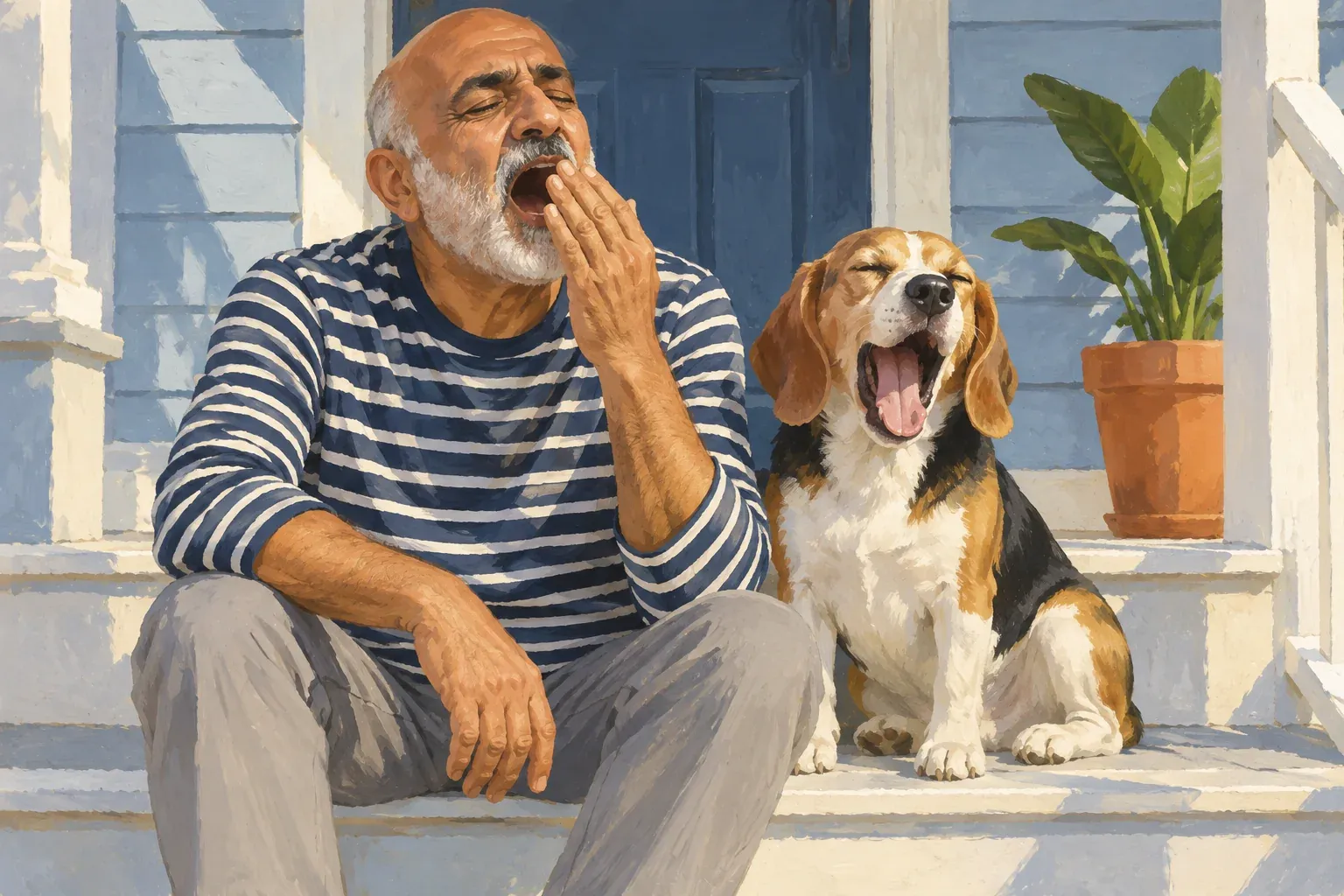
Familiar faces seem to help, as they do in people. A 2013 study at the University of Tokyo, published in PLOS ONE, watched 25 pet dogs and found they yawned more when their owners yawned than when a stranger did. If you have a dog, try a slow yawn while it’s looking at you.
What scientists still don’t know
Nobody has settled why yawning exists at all. The cooling idea has the most experiments behind it, but most of those measured yawns and air temperatures, not brains in the act.
The empathy question is still open, and the dog studies don’t agree with each other.
A few things are solid. Yawning starts early, and a 1982 ultrasound study led by Johanna de Vries in the Netherlands recorded yawns from about 11 weeks into pregnancy. You also yawn most when you’re sleepy, and people who kept a yawning diary for Provine yawned most in the hour after waking.
One test for tomorrow morning
Write your tally down now. Tomorrow at breakfast, yawn once where someone in your family can see you, and watch the clock for three minutes, the window the Pisa study used.