home · 6 min read
Why Bathroom Mildew Keeps Coming Back: The Humidity Number to Watch
Bathroom mildew grows when humidity stays high. Learn what mildew is, why it returns and the humidity range EPA recommends.
By Porch Daily editors · Updated October 2026

Mildew is mold, and most people use the word for the kind that spreads as a thin grey, black or whitish film across a surface. In a bathroom, you’ll find it as dots along the grout lines, a dark edge on the caulk around the tub and a speckled patch on the ceiling over the shower.
The Environmental Protection Agency’s online course on mold treats the two words as one family, describing molds as “also called fungi or mildew.”
If you scrub the grout every few weeks and the dots come back anyway, your scrubbing is fine. Your bathroom stays wet for too long.
Mildew is mold that stays on top
“Mold” is the umbrella word, and “mildew” is what most people call the flat growth on tile, glass, painted walls and shower curtains, where a brush can reach it.
The difference matters when you decide what to do. Mold that has worked into something soft and absorbent is a bigger job, and the EPA says porous materials such as ceiling tiles and carpet “may have to be thrown away” once they’re moldy.
Color won’t sort them for you. The EPA’s course points out that molds come in many colors, white included, and that “black mold” is not a species or a specific kind of mold.
Where it sits tells you more. Growth on a hard surface that wipes away with a wet cloth is the everyday kind. Dark spots inside the caulk or bubbling under the paint mean you’re looking at more than a quick scrub.
Why it keeps coming back
Mold spores are already in your bathroom, and in every other room of your house. The EPA puts spores at 2 to 100 microns across, small enough to ride in on ordinary air. No cleaner you buy stops new ones from landing on your clean grout the next day.
What a spore needs after it lands is food and water. The EPA calls moisture “the most important factor” in mold growth indoors.
Food is easy to find in a shower, where soap film and the oils that rinse off your skin leave a thin layer on the grout and caulk.
Warmth matters less than you might guess. The EPA says temperature usually isn’t the issue, since some molds like warm spots while others grow on bread in a refrigerator.
Daily showers never let it dry
The clock is the part most people miss. After a leak or spill, the EPA advises drying wet materials within 24 to 48 hours, since in most cases, items dried in that window don’t become moldy. That figure is for one soaking, and a shower soaks the same tile again and again.
A shower you use every morning is wet again before 24 hours have passed, and the grout in a shady corner may not dry all the way between your showers at all.
Condensation adds to the problem whenever warm, moist air from your shower meets a cold surface, such as a window, an outside wall or a ceiling under the attic, and water beads up there. The EPA’s course says “a little condensation, in a bathroom or around a window sill” can be enough for mold, which explains why the speckles so often start in those cold corners.
The humidity range to aim for
The EPA’s brief guide to mold and moisture, last updated in February 2026, says to keep indoor humidity below 60 percent, and ideally between 30 and 50 percent. The Centers for Disease Control and Prevention draws a tighter line for mold, telling households to keep humidity “no higher than 50%” all day long.
Your bathroom can easily shoot past 60 percent during a hot shower, and that’s normal. What counts is how fast the number falls afterward.
To find out, you need a humidity meter, also called a hygrometer. The EPA describes it as a small, inexpensive tool, $10 to $50 at many hardware stores. Set one on a shelf away from the spray and read it before you shower, right after you step out and again once the room has sat empty for a while. A last reading still above 60 means the wet air isn’t leaving fast enough.
Small habits that dry the room
The EPA’s bathroom advice is short: “Run the bathroom fan or open the window when showering.” Keep the fan going after you’re out, too, at least until the mirror clears. A fogged mirror tells you the air is still wet enough to bead on glass.
A squeegee handles the walls. Pull it down the tile and the glass from top to bottom after each shower, and most of the water that would have sat in the grout all morning goes down the drain instead.
It takes about as long as brushing your teeth.
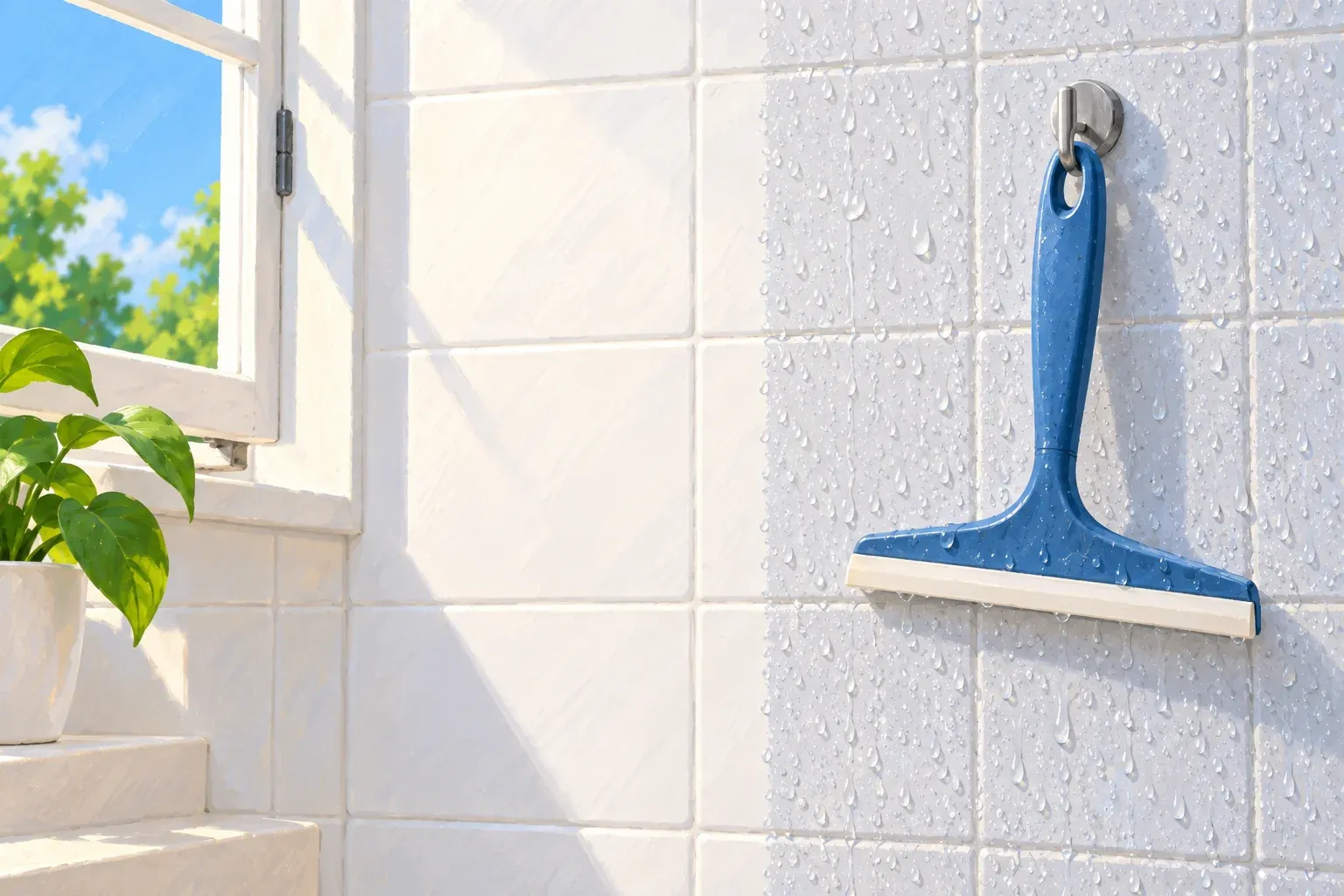
The rest takes a few seconds: spread the towels out instead of folding them over one bar, hang the bath mat over the tub edge and pull the shower curtain closed so its folds can dry flat.
A bathroom without a window depends on its exhaust fan alone. Hold a single square of toilet paper near the grille while the fan runs. If the paper barely moves, the fan may not be pulling much air, and that’s a job for an electrician or a ventilation contractor to look at.
Cleaning the patch you have now
The EPA’s cleanup advice for hard surfaces has two steps: scrub the mold off with detergent and water, then dry it completely. Its guide says bleach and other mold-killing chemicals aren’t recommended as a routine part of mold cleanup.
Never mix cleaners. The EPA warns that chlorine bleach combined with products containing ammonia can give off toxic fumes. Run the fan or open the window while you work, and wear long gloves and goggles, as the EPA’s guide recommends.
Don’t caulk or paint over mildew, either. The EPA says to clean and dry a moldy surface before you paint it. Caulk with dark spots inside it, where a brush can’t reach, is usually easier to cut out and replace once the area is dry.
How much of the job is yours depends on the size of the patch.
| Size of the moldy area | What the EPA says |
|---|---|
| Less than about 10 square feet, roughly 3 feet by 3 feet | In most cases, you can handle the job yourself |
| More than 10 square feet, or a lot of water damage | Use its guide for larger cleanups. If you hire a contractor, pick one with mold experience and check references |
For bigger jobs, the EPA points to its guide called Mold Remediation in Schools and Commercial Buildings.
Who should watch the meter
Some bathrooms are set up for mildew from the start. A room with no window depends entirely on its fan. A shared bathroom where three or four people shower back to back never gets a dry hour in the morning. A bathroom on an outside wall in a cold climate gets condensation every winter, on the window glass and in the ceiling corners.
If that sounds like yours, the meter is worth more than a stronger cleaner. You’re aiming for a room that drops back under 60 percent soon after the last shower, with dry walls before the next one starts.
Before your next shower
60 percent is the reading to beat. Set the meter on a shelf tonight, then run the fan through tomorrow’s shower and squeegee the walls before you reach for a towel. Check the number before you leave the house. If it has dropped back under 60 by then, the grout you scrub this weekend has a much better chance of staying clean.