home · 8 min read
Why Are So Many Front Doors Red? 7 Door Color Traditions and the Stories Behind Them
Red front doors come with a pile of stories, some true and some folklore. Seven door color traditions from around the world.
By Porch Daily editors · Updated October 2026
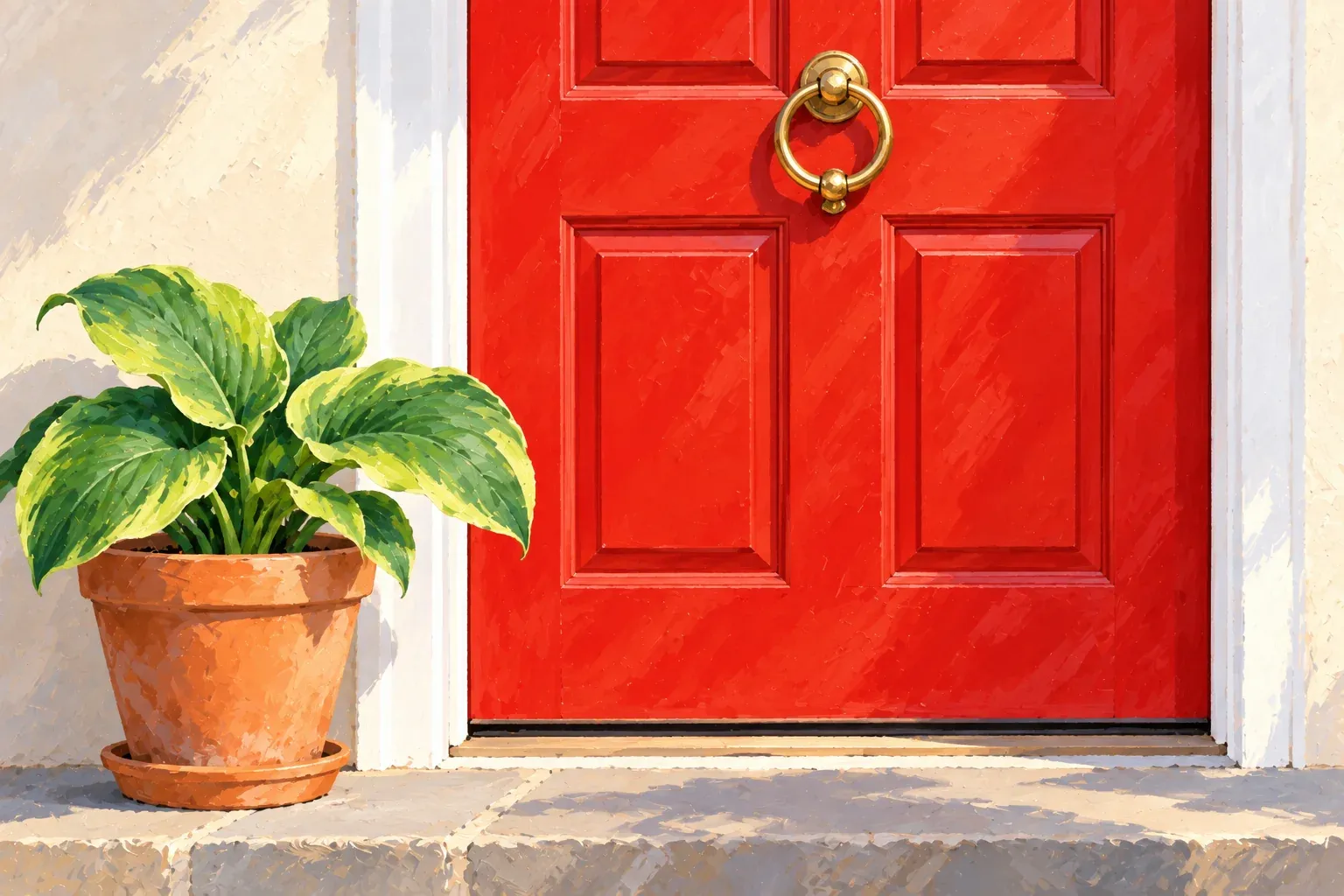
Paint your front door red and somebody will tell you what it means. One neighbor will say the mortgage must be paid off, another will say it brings luck, and a friend who grew up Episcopalian will tell you the churches had red doors first.
Some of those stories come with laws, dates and museum pieces behind them. Others spread by postcard and tour guide, and nobody has ever traced them to an old record of any kind. Sorting the two is half the fun, and the door you pass tomorrow morning probably carries a story of one kind or the other.
1. Red church doors and sanctuary
In medieval England, a person accused of a crime could take refuge in a church, and the sheriff’s men couldn’t drag them back out. At Durham Cathedral the claim began at the north door. A fugitive who reached the bronze knocker there got 37 days of protection, according to the guide published by the Durham World Heritage Site, time enough to make peace with an accuser or plan an escape.
The monks gave each one a black robe with St Cuthbert’s cross sewn on the left shoulder. The knocker you’d touch on a visit today is a copy, and the 12th-century original sits in the cathedral’s museum.
Parliament abolished the right of sanctuary in 1624.
Where the red paint came in
The red paint is the shaky part. Many Episcopal churches in the United States paint their doors red. Ask the rector and you’ll hear it stands for sanctuary, for the blood of Christ, or for the Passover blood that the Book of Exodus says marked the doorposts of Israelite homes.
The sanctuary law sits in the statute books, but no medieval order telling churches to paint those doors red has ever turned up.
The color looks like a later way of remembering a law that did exist.
2. The paid-off mortgage door in Scotland
This is the story you’re most likely to hear at a cookout. When a Scottish family paid off the house, it goes, they painted the front door red to let the whole street know.
It’s folklore.
The tale shows up again and again on home blogs and in real estate newsletters, yet none of the people telling it point to a diary, an old newspaper notice or a collector of Scottish customs who wrote it down. It reads like a story someone made up to explain red doors after the fact.
Scotland’s real doorstep custom
Scotland does have a doorstep custom with a long record. At Hogmanay, the Scottish New Year, the first person to cross the threshold after midnight is called the first-foot, and tradition says a tall, dark-haired visitor carrying coal, shortbread or whisky brings the best luck for the year ahead.
If your own mortgage is paid off, you’re free to paint the door any color you like.
3. Red for luck in feng shui
Feng shui is the old Chinese practice of placing buildings and rooms to keep energy, called qi, flowing well. In its teaching each compass direction belongs to an element. The south belongs to fire, whose color is red. Check which way your own front door faces the next time you step out. If it faces south, feng shui would paint it red.
Red means luck and celebration all through Chinese tradition, well beyond feng shui. Before Lunar New Year, families paste couplets written on red paper on either side of the front door. The next new year falls on February 6, 2027, if you’d like to look for the custom in your own neighborhood.
The red gates of Beijing
The grandest red doors in China are the gates of the Forbidden City in Beijing, home to the Ming and Qing emperors. All but one of them are studded with golden door nails set in nine rows of nine, 81 in all, since nine was the emperor’s number.
Feng shui is a living tradition. Whether a red door brings luck is a matter of belief, but the custom is old, well documented and still widely followed.
4. The bright doors of Georgian Dublin
Dublin’s Georgian squares went up as matching rows of brick townhouses. Merrion Square was laid out in 1762 and Fitzwilliam Square in 1792, and on both, the houses share the same height, the same windows and the same half-round fanlight over each door. The door is the one place where a household can look different from the house next door.
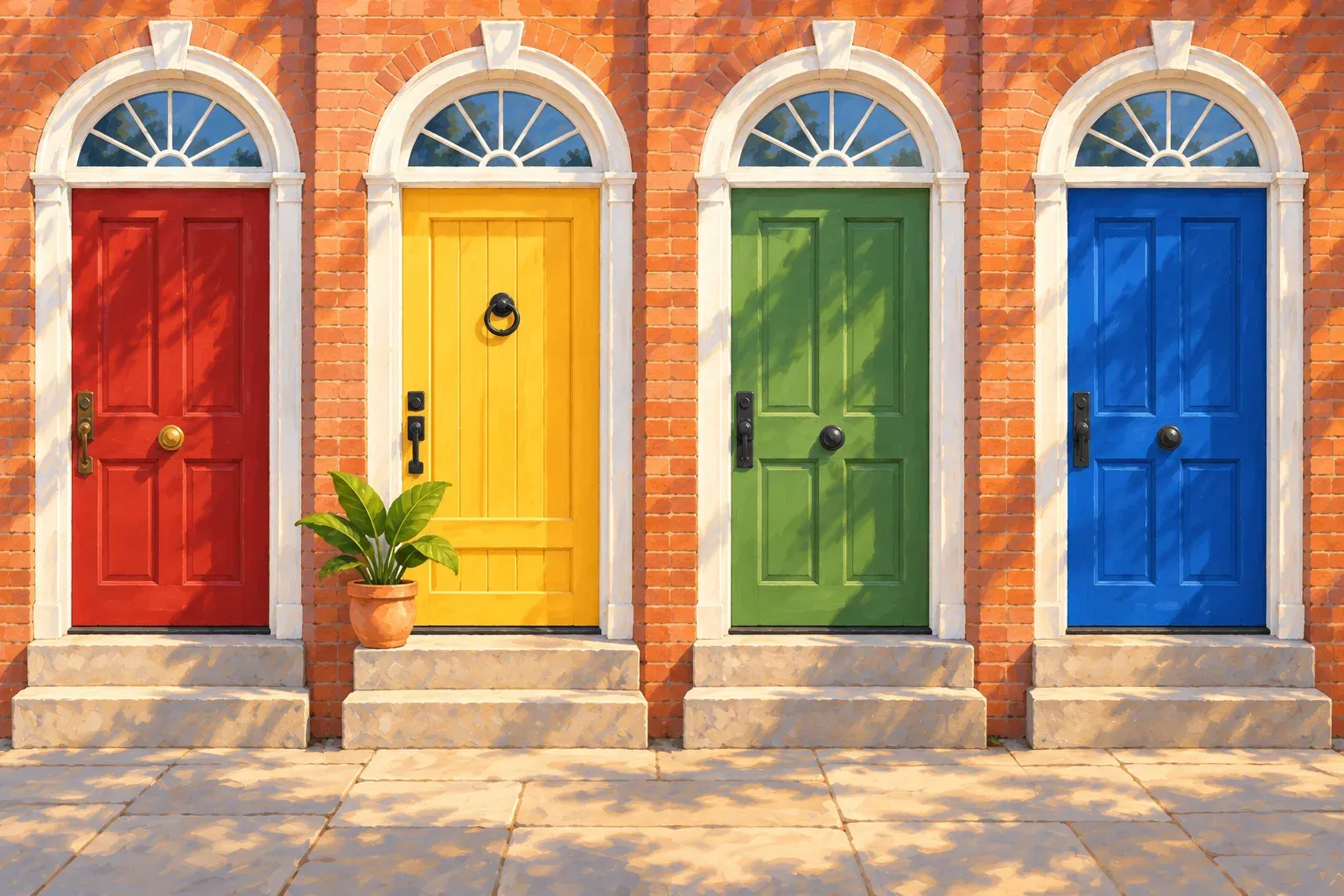
Today those doors come in red, yellow, green, blue and nearly every shade between, and a walk around Merrion Square lets you count them yourself. The most popular explanation says that when Queen Victoria died in January 1901, Dubliners were told to paint their doors black in mourning and painted them bright colors instead, out of spite. A second version says wives painted the doors so husbands coming home from the pub could find the right house.
What the record shows
Nobody has produced the mourning order, and the pub story has no source at all. What’s on record is a poster. Around 1970 the Irish Tourist Board put out The Doors of Dublin, a grid of photographs of painted Georgian doorways, and it carried the colors around the world. A copy now sits in the collection of the Cooper Hewitt, the Smithsonian’s design museum in New York.
If you ask a Dublin tour guide, you’ll likely hear the Victoria tale first. It’s the best story in this whole list, and the flimsiest.
5. Black doors on London townhouses
London’s black doors had a practical job, which was hiding soot. For centuries the city heated itself with coal, and the smoke left a dark film on every brick, railing and windowsill. During the Great Smog of December 1952, the Met Office estimates, London put 1,000 tonnes of smoke particles into the air each day. A pale door in that air needed constant scrubbing, while a dark one could go years between coats of paint and still look tidy.
The deep black you probably picture is a newer habit than it seems, though. The paint historian Patrick Baty studied the old paint layers on the Georgian railings of Bath. He found grey and stone colors through the 1700s and early 1800s, then dark green from about 1850, with black arriving only in the late 20th century.
He also says black railings have nothing to do with mourning for Prince Albert, a story plenty of people still believe.
The most famous black door
If you’ve watched a British prime minister wave from the step on the news, you’ve seen the most famous one. The front door of 10 Downing Street was made of black oak around 1772. After an IRA mortar attack in February 1991, it was replaced with a blast-proof steel copy so heavy that it takes eight men to lift. The Clean Air Act of 1956 helped clear the soot from London’s air, but by then a black door had become the look of a smart London address.
6. Blue doors on the Greek islands
If you’ve seen a postcard from Santorini, you know the look. On the Cyclades, the island group that includes Santorini and Mykonos, the houses are whitewashed and the doors, shutters and window frames are often blue. The white has a plain explanation. Lime whitewash was cheap, it bounced the summer sun off thick stone walls, and lime kills germs.
Laundry powder, flags and dictators
The blue comes with more stories. One common account says islanders tinted their paint with loulaki, a blue laundry powder once found in most Greek homes. Two more say dictators ordered the colors, first Ioannis Metaxas to fight cholera in 1938 and then the military junta that ran Greece from 1967 to 1974, to match the flag.
Parts of that check out. Greece adopted its blue-and-white flag on January 13, 1822, and the junta did make the striped version the national flag by decree in 1969. The painting laws themselves are much harder to find, and tour guides tell those stories with more confidence than the records support.
Some islanders also see the blue as protection from the evil eye, the same belief behind the blue glass eye charms you’ll find hanging in Greek doorways.
7. Why yellow doors feel friendly
Yellow doors are the open question on this list. There’s no old law or legend behind them, yet you’ve probably heard someone call a yellow door cheerful, and you may have thought it yourself.
What color studies found
Color research offers a hint. In a 2020 study in the journal Psychological Science, 4,598 people in 30 nations matched colors to emotions, and most of them linked yellow with joy. An earlier study in the Journal of Environmental Psychology found that link was stronger in people who live farther from the equator and in rainier places, which suggests yellow reads as sunshine to the people who see less of it.
Neither study asked anyone about front doors, so the friendly yellow door is still a good guess with no proof behind it. Think of the friendliest-looking door on your own street and notice what color it is.
On your next walk
Look at the front doors as you pass and see how many of these seven stories you can spot on one block. You’ll probably find a red one, a black one and at least one color nobody has a legend for. When you get home, stop on the step and look at your own front door, all the way down to the paint worn thin around the knob.