relationships · 6 min read
Where Did the Handshake Come From? A Short History of How People Say Hello
An Assyrian carving from about 846 BCE shows two kings shaking hands. A short history of greetings, up to the elbow bump of 2020.
By Porch Daily editors · Updated October 2026
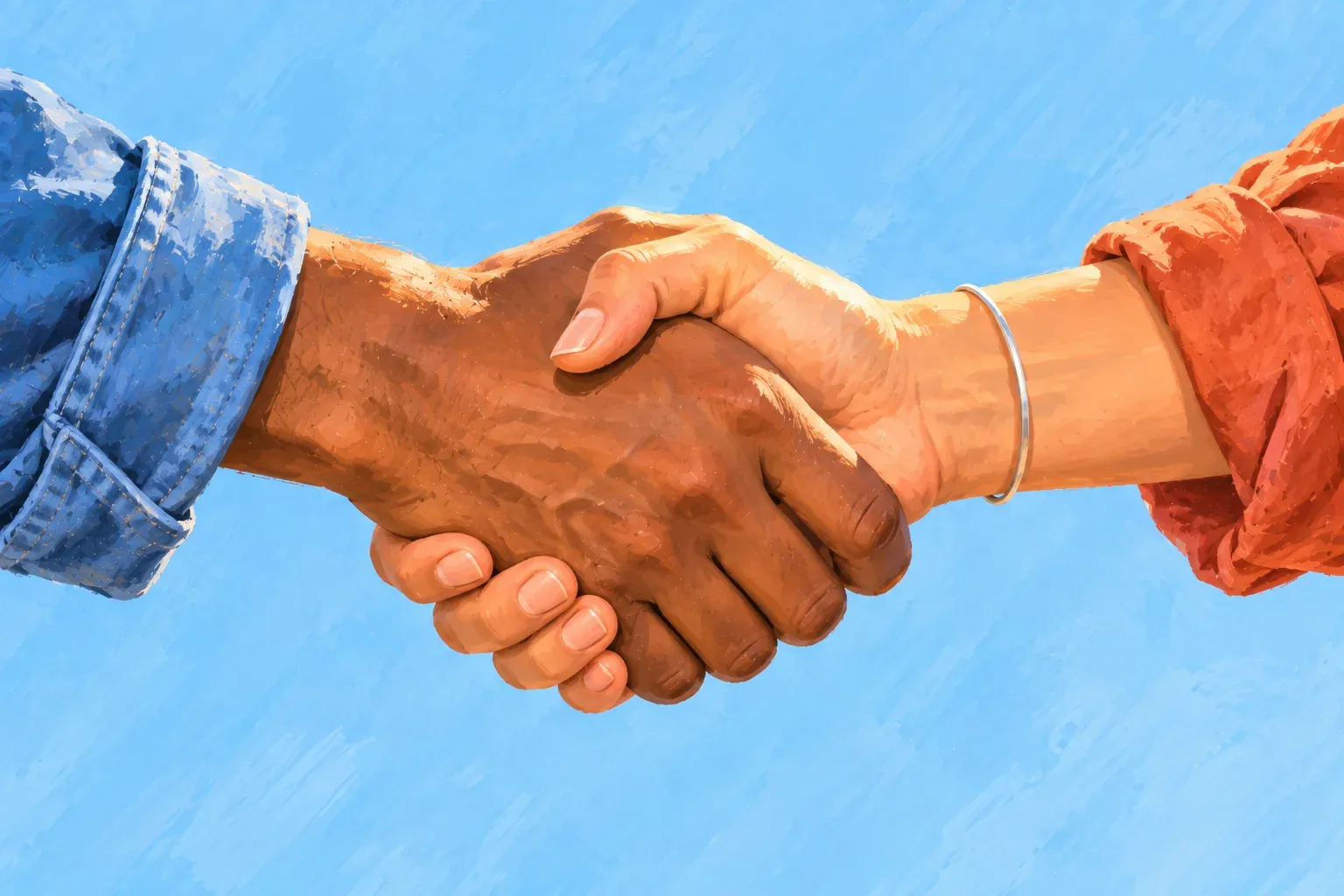
A greeting ritual is the small, agreed-on move two people make when they meet, like a handshake, a bow, a kiss on the cheek or a wave across the street. It tells the other person you’ve seen them and hints at how you see the two of you.
You probably did several of these yesterday without a thought, and each one has a backstory. The handshake has the longest paper trail of the lot.
It starts with a stone platform carved for an Assyrian king almost 2,900 years ago.
Two kings shake on a deal
In 1962, archaeologists digging at Nimrud, in what is now northern Iraq, uncovered a stone throne platform in the throne room of a fortress built by Shalmaneser III, who ruled Assyria from 858 to 824 BCE. The carving on its front shows Shalmaneser clasping hands with Marduk-zakir-shumi, the king of Babylon, while guards stand behind each man under a fringed canopy.
That handshake marks an alliance. Shalmaneser had backed Marduk-zakir-shumi against a rebellious brother who wanted the Babylonian throne. World History Encyclopedia dates the finished platform to about 846 BCE.
The platform is on display in the Assyrian Gallery of the Iraq Museum in Baghdad, and World History Encyclopedia notes that it came through the 2003 looting of the museum undamaged.
Greek graves show a goodbye
Athenian sculptors carved handshakes onto gravestones. A marble relief from about 410 BCE, now in the antiquities collection of Berlin’s state museums, shows two soldiers named Sosias and Kephisodoros joining their right hands.
Art historians call the pose dexiosis, from the Greek for offering someone your right hand. The same noun also meant hospitality, while its verb came to mean to greet, or to welcome a guest. On many grave markers the clasp is a farewell between the person who died and someone who lived on.
You’ve likely heard why it’s the right hand. An open right hand shows the other person you aren’t holding a sword. It’s a popular explanation and a tidy one, but historians haven’t settled where the gesture began. The carvings themselves don’t explain it either.
Quakers shook hands with everyone
For most of history, a handshake was for equals, and most meetings weren’t between equals. If you lived in 17th-century England, you bowed, took off your hat or curtsied to anyone above you. The depth of your bow showed where you stood.
The Quakers, a Protestant group that took shape in England in the 1650s, refused to play along. Historian Penelope Corfield of Royal Holloway, University of London, writes that they would not bow or curtsy to their social “betters,” and that all Quakers, men and women alike, shook hands instead. Their stubborn habit startled the people around them at first.
Over time, it helped make the handshake ordinary.
By 1815, Jane Austen could close a farewell in Emma with “a very friendly shake of the hand” from Frank Churchill to Emma Woodhouse, with no explanation needed for her readers.
Bows and pressed palms
The handshake is one answer among many. Other greetings put the respect in the angle of the body, the height of the hands or the number of kisses.
In Japan, a light bow from the waist does for colleagues, while clients, bosses and apologies call for a deeper one. Namaste, used across India and Nepal, presses the palms together with a slight bow. Its Sanskrit roots mean “bowing to you.”
In Thailand’s wai, the palms press together too, and the higher you hold your hands next to your face, the more respect you show.
Cheek kisses come with math
France has its own rules. Linguist Mathieu Avanzi surveyed more than 18,000 people about French speech habits between 2016 and 2019. His results show two kisses is the rule in most of the country. In Finistère, at the western tip of Brittany, about 70 percent of people give just one, while parts of the south give three and a few areas go up to four.
| Greeting | Where it’s common | What it signals |
|---|---|---|
| Handshake | US, UK and much of Europe | Two people meeting as equals |
| Bow | Japan | Respect, with a deeper bow for more of it |
| Namaste | India and Nepal | Respect, with no touch needed |
| Wai | Thailand | Respect, shown by how high the hands go |
| Cheek kisses | France, Belgium, French-speaking Switzerland | Warmth among friends and family |
| Hongi | New Zealand, among Māori | Two people sharing one breath |
In the Māori hongi, two people press their noses together, often touching foreheads too, to share the ha, or breath of life.
Even the French get tangled up. The Local, an English-language news site in France, reported that Avanzi ran a second survey of 11,000 people on which cheek comes first, and 15 percent weren’t sure or said it could be either.
The year everyone improvised
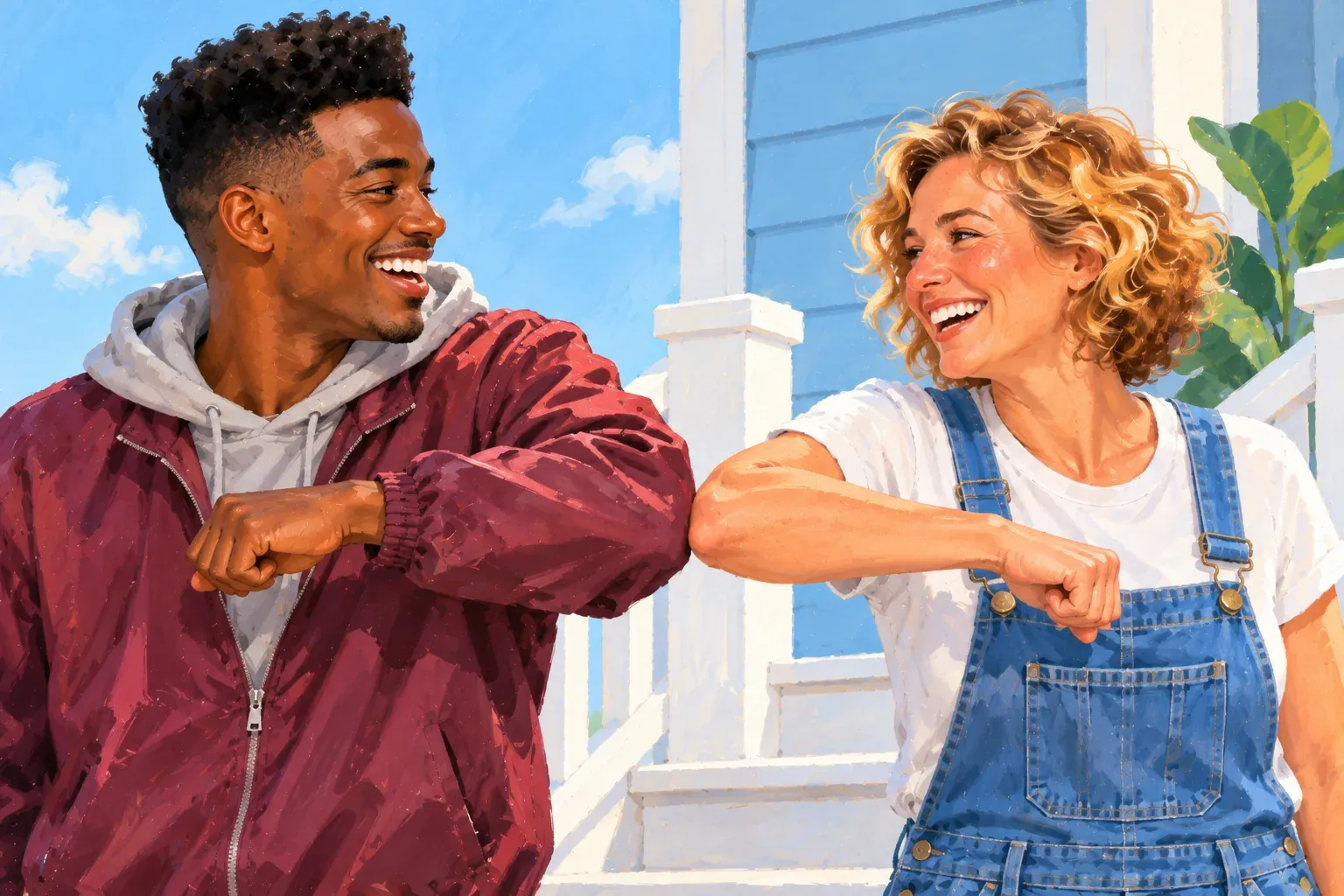
In early 2020, handshakes went on hold across much of the world. People invented stand-ins on the spot, from foot taps to waves from the end of the driveway.
Kenya’s Daily Nation kept track of some famous ones. Joe Biden and Bernie Sanders bumped elbows before their CNN debate on March 15, 2020, and Tedros Adhanom Ghebreyesus, the head of the World Health Organization, said he preferred to put his hand on his heart when he greeted people.
Namaste got a lift of its own. The Daily Nation reported that French President Emmanuel Macron greeted Spain’s king and queen with one, and Kenya’s president, Uhuru Kenyatta, and his officials used it too.
What a handshake does for a first impression
The handshake came back, and there’s some evidence it does real work. In a 2012 study in the Journal of Cognitive Neuroscience, Florin Dolcos and Sanda Dolcos at the University of Illinois put 18 volunteers in a brain scanner and showed them short animated scenes of people meeting in a business setting.
When a handshake opened the scene, volunteers rated the friendly meetings more positively. They also judged the unfriendly meetings, where one character avoided the other, less harshly. The scans also showed more activity in the nucleus accumbens, a brain area tied to reward, when the characters shook hands.
That’s a small study, and those were cartoon handshakes. It still fits the long history, in which the first move sets the tone for whatever comes after it. When you meet someone new, try making the greeting the first thing you do, before you reach for anything to say.
Before you close the screen door
You have a whole table of greetings to choose from, and so does everyone you meet. The next time you meet someone new, watch which greeting they reach for first, whether it’s a hand, a nod, a wave or a cheek, and answer them in kind. If they hang back, offer yours first and let them match you.