family · 7 min read
How to Make School Mornings Calmer With a Picture Checklist Your Kids Can Follow
A picture checklist and ten minutes of night-before setup can make school mornings calmer. Six steps for parents.
By Porch Daily editors · Updated October 2026

The average public elementary school in the United States starts at 8:16 a.m., according to the National Center for Education Statistics’ survey of school principals for the 2020-21 school year. Count back from that bell, and the window between the alarm and the front door gets short.
The hour usually goes fine until about 7:40. That’s when someone needs a library book, a signed form, a jacket for today’s weather and the left shoe, all at once.
Behind each of those is a small decision, made in a hurry by a tired adult and a seven-year-old. You can make every one of them the night before, then let a picture checklist on the wall do the reminding for you.
1. List every morning task
Walk through a normal school morning and write down everything that has to happen before the door closes. Count the hidden jobs too, like finding the other shoe or signing a reading log.
Then split the list in two. Your side holds jobs like making lunch and finding your keys. Your child’s side holds what they can do alone or nearly alone: get dressed, eat breakfast, brush teeth, use the bathroom, put on shoes and grab the bag. Six tasks, one picture each, fit on one sheet.
Holding a list like this in mind takes working memory, one of three skills that Harvard University’s Center on the Developing Child groups under executive function. The second is inhibitory control, the skill that lets you ignore the cat when you should be putting on socks. The third is cognitive flexibility, which lets you switch gears. The Center’s activities guide says children aren’t born with these skills, only with the potential to build them. It adds that the skills keep developing into early adulthood.
A young child’s head isn’t the right place to store the morning yet. Your finished list fits on an index card, in the order things happen at home.
2. Draw it as a picture checklist
Give each task on your child’s side a picture: a sun for waking up, a shirt, a cereal bowl, a toothbrush, a pair of shoes and a backpack. For a child who can’t read yet, drawings do the whole job. Stick figures are fine, and your child can color some of them in.
The University of Wisconsin-Madison Division of Extension suggests the same thing in its Parenting the Preschooler series, a morning routine chart with pictures and drawings that remind children what to do.
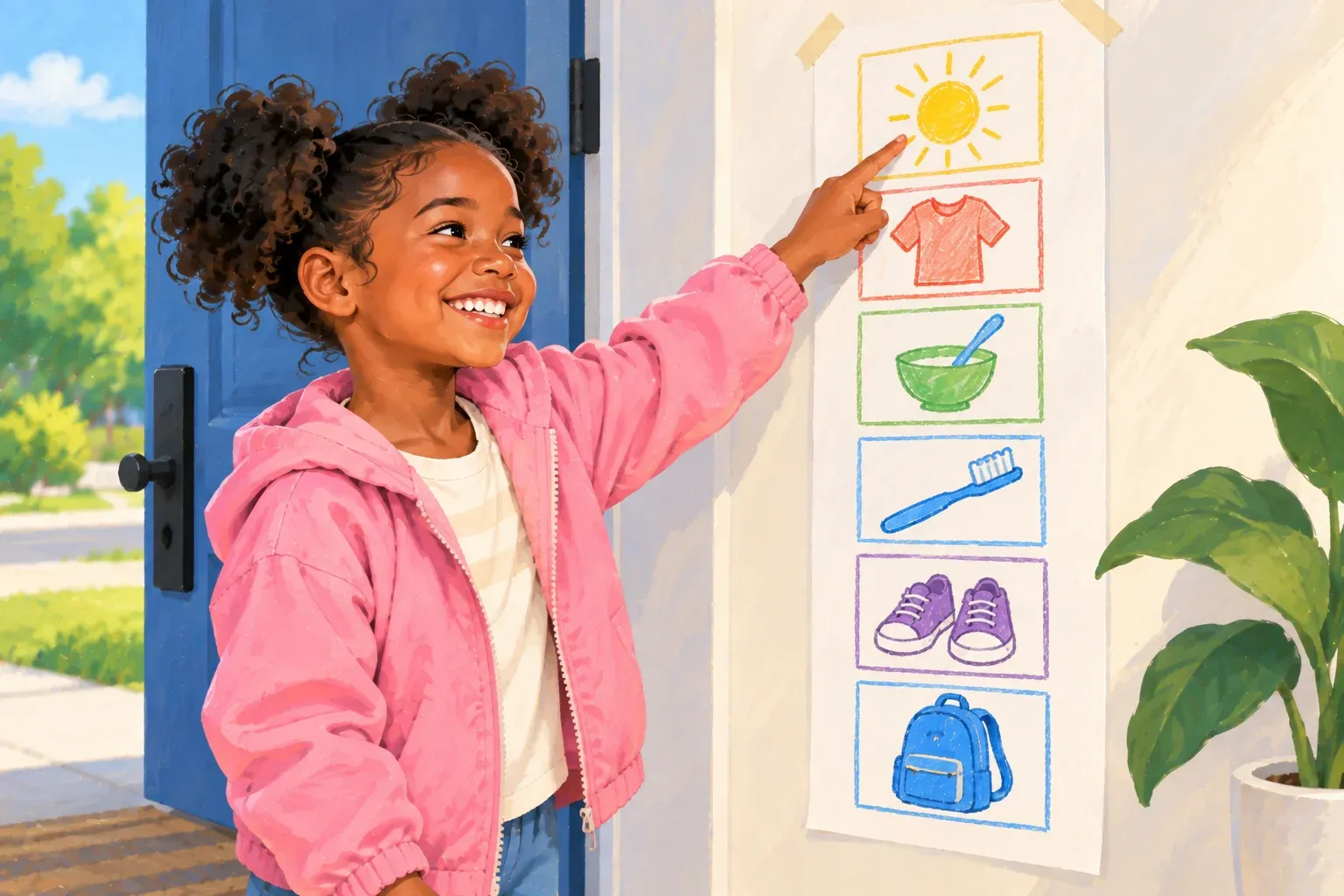
Tape the chart up at your child’s eye level, where they can see the next picture without asking you. The hallway by the front door works in a lot of homes, since the last two pictures happen there anyway. Add a way to track progress, like a clothespin your child slides down the edge after each picture.
When the chart is up, your child can stand in front of it and walk you through the morning by pointing.
3. Set out clothes and pack bags at night
The same Wisconsin series calls preparing the night before a key to a smooth morning. It names three jobs: make lunches, pack backpacks and set out clothes.
Check tomorrow’s weather while you’re at it and pick the jacket then. If your child likes to choose, offer two outfits and let them pick before bed, when nobody is waiting in the car. Signed forms, library books and the gym shoes for Tuesday go in the bag before anyone brushes their teeth.
All of it takes about 10 minutes after dinner. By bedtime, tomorrow’s clothes are on a chair, the lunch is in the fridge and the bag is zipped.
4. Give everything one spot by the door
Shoes, jackets, backpacks and your own keys and bag all go to one place by the door, every night. A low hook your child can reach and a basket for shoes will do it. Any furniture you already own works, as long as the spot never moves.
This step is for you, too. A checklist can’t help you if your keys are in yesterday’s coat pocket.
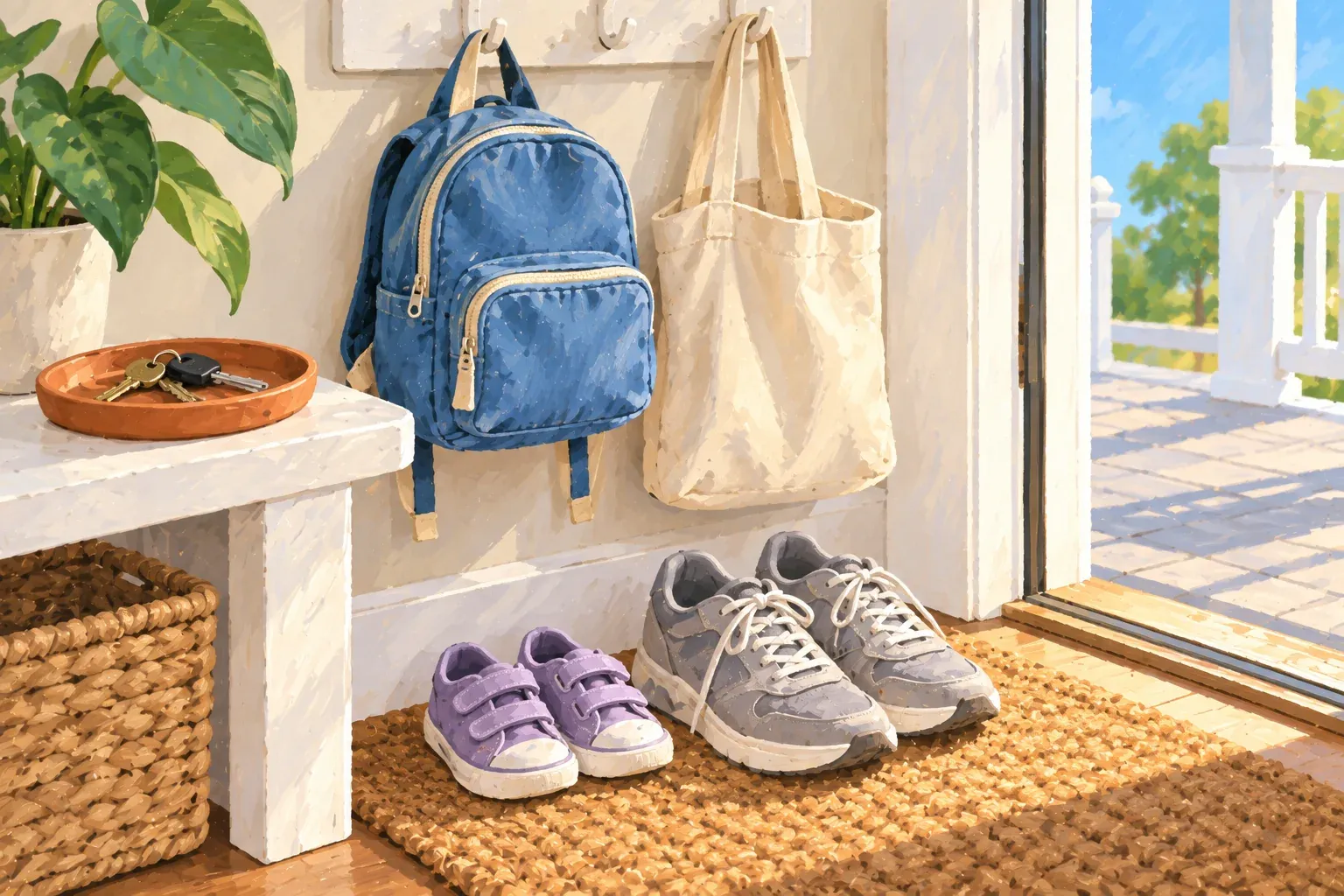
In the morning, nobody walks back upstairs for anything.
5. Work back from the time you leave
Start with the time you need to be out the door and count backward. If the bell rings at 8:16, the national elementary average, and the drive plus the drop-off line takes 20 minutes, you’d leave by 7:45 with a few minutes to spare.
Then give each picture on the checklist a realistic number of minutes. In the example below, the alarm goes off at 6:45, breakfast starts at 7:00, teeth at 7:20 and shoes at 7:30, and the 10 minutes from 7:35 to 7:45 hold nothing at all.
| Time | What happens |
|---|---|
| 6:45 | Wake up, get dressed in the clothes on the chair |
| 7:00 | Breakfast |
| 7:20 | Teeth, hair, bathroom |
| 7:30 | Shoes, jacket and bag from the spot by the door |
| 7:35 | Buffer, nothing planned |
| 7:45 | Out the door |
Example: a morning built backward from a 7:45 departure. Swap in your own leave time and drive.
The buffer is the step most parents skip. It’s the one that keeps a spilled bowl of cereal from turning into a late slip. If you can’t find those 10 minutes, take them from the evening by moving one more job to the night before.
You’ll know the timeline works when the buffer is still empty at 7:35 on most days.
6. Praise the checklist, not the speed
When the morning goes well, say exactly what your child did, like getting through every picture on the chart without a reminder from you. The CDC’s parenting pages for toddlers and preschoolers call this labeled praise. They explain that specific praise works better than a general cheer, since your child then knows exactly what you liked.
Praising speed teaches a different lesson. A child who hears that they were fast learns that fast is the goal, even if the toothbrush got skipped on the way out.
Harvard’s Center on the Developing Child describes the adult’s job as scaffolding. You help with a hard task at first, then gradually step back as the child is ready to manage it alone. On a school morning that means standing by the chart for the first few days, then moving to the kitchen, and later checking only the last picture.
Once the chart is a habit, your main morning job is checking that every picture got done.
Count back to bedtime, too
In June 2016 the American Academy of Sleep Medicine published its first consensus on how much sleep children need, from a 13-member panel that reviewed 864 studies. The American Academy of Pediatrics endorsed it. For children 6 to 12, the panel’s answer is 9 to 12 hours a day on a regular basis.
| Age | Recommended sleep per 24 hours |
|---|---|
| 3 to 5 years | 10 to 13 hours, naps included |
| 6 to 12 years | 9 to 12 hours |
| 13 to 18 years | 8 to 10 hours |
From the American Academy of Sleep Medicine’s 2016 consensus in the Journal of Clinical Sleep Medicine. The panel tied too little sleep in children to attention, behavior and learning problems.
A CDC report from January 2018 found that 57.8% of middle school students in the nine states that asked about sleep got less than the recommended amount for their age on an average school night in 2015.
Run the work-back one more time. A 6:45 alarm and 9 hours of sleep means asleep by 9:45 p.m., and 10 hours means asleep by 8:45. Asleep isn’t the same as in bed, so the bath and the story start earlier than that.
If your child gets the full amount and still drags every morning, bring it up at the next check-up.
Before the porch light goes off
Tonight around 8, on the hallway floor by the front door, sit down with your child, a sheet of paper and a box of crayons. Draw the six pictures together and tape the sheet up at their eye level. Then lay tomorrow’s clothes on a chair, zip the bag, and hang it on its hook before anyone heads upstairs.
At 7:40 tomorrow, when someone asks what comes next, you can point at the chart.